
Coordinating a Sengoku-era alliance with friends turns the 2011 base game into one of the most replayable Total War entries, and the campaign lobby is where every shared or head-to-head match begins. This walkthrough covers the Shogun 2 how to play co op campaign flow from the multiplayer button all the way to realm-divide diplomacy, including the eight-player cap, naval fleet rules, and the unwritten courtesies that keep Sengoku lobbies civil. Whether the goal is a 2v2 against AI or a chaotic free-for-all, the right lobby settings decide whether a four-hour Saturday night ends in a screenshot or a rage quit.
Getting a Co-Op Campaign Lobby Running
Multiplayer in Shogun 2 opens from the main menu through the dedicated button, and the launcher immediately branches into Campaign, Custom Battle, and Avatar Conquest. For a shared Sengoku experience the Campaign tab is the destination, and the host's first job is choosing between cooperative and head-to-head. The two paths share a lobby shell, but they diverge on diplomacy, victory, and how armies trade hands, so a quick decision here prevents a mid-game argument about who actually owns Kyoto.
Choosing Co-Op Versus Head-to-Head
In co-op, two human clans share a single faction roster, pool income from held provinces, and divide agents between them; the AI simply fills the remaining clan slots. In head-to-head, every human player is a separate clan with its own treasury, and victory is decided by short or long campaign conditions rather than a shared realm-divide trigger. Picking co-op for a friends-only night and head-to-head for a tournament stream keeps the rulebook honest.
Lobby Slots, Faction Picks, and the Eight-Player Cap
The lobby grid caps at eight slots total, mixing humans and AI, and the host can lock, kick, or AI-fill any empty seat before launch. Faction choice has to be unique per slot, and the host can prevent late swaps by locking the roster once everyone is ready. Realm Divide still fires for the human side, so co-op duos should plan to defend together once every AI clan declares war in sequence rather than treating the trigger as a private event.
| Setting | Co-Op Effect | Head-to-Head Effect |
|---|---|---|
| Human slots | Shared faction | Independent factions |
| Treasury | Pooled per turn | Per-clan treasuries |
| Victory | Survive realm divide | Short/long campaign target |
| Realm Divide | Triggers for humans only | Triggers per faction |
| AI slots | Fill remaining clans | Optional rivals |
Launching a Co-Op Campaign Session
A working Shogun 2 how to play co op campaign session hinges on three details that trip up first-timers: Steam visibility, region lock, and save game ownership. The host's campaign save is the one that gets reloaded on disconnect, so the player who clicked "Start Campaign" should be the one who is least likely to crash or alt-tab. Friends joining from another continent usually see the lobby drop on the first attempt because Steam sometimes routes the host's region flag incorrectly, and a Steam restart fixes it more often than a router reboot.
Region, Ping, and Connection Health
The lobby shows a ping column, and anything over 200 ms makes real-time battles feel like a slideshow. Cross-region co-op works, but the host should disable the "Allow Friends From Other Regions" only if both players are on the same continent; mixed-region play benefits from leaving it on and accepting higher latency for stable reconnects. Players who only want to play a custom battle can skip the campaign lobby entirely and use the Custom Battle matchmaking pool, which is where most of the Shogun 2 8 player battles happen in the wild. Once you're in the thick of those chaotic clashes, stacking your roster with hard-tested elites from Shogun 2 Veteran Units Multiplayer can make the difference between a fleeting skirmish and a decisive late-game push.
Save Game and Reconnect Rules
If a co-op partner drops, the host can keep playing the turn and the absent player rejoins on the next campaign tick. Saves only write on the human host's machine, which is why a "host crashed" recovery is really a "load the host's last autosave" recovery. The same rule applies to naval engagements triggered inside the campaign, since the realtime battle runs through the host's client, and the drop in the ocean will be re-fought from scratch on the next connect.
| Connection Symptom | Likely Cause | Fix |
|---|---|---|
| Lobby invisible to friend | Steam offline mode | Restart Steam in online mode |
| Ping over 200 ms | Cross-region host | Reroute via closer host |
| Drop on turn end | Save not flushed | Wait 5 s before Alt-Tab |
| Battle freezes | Host alt-tabbed | Avoid Alt-Tab during deployment |
Naval Multiplayer and Custom Battle Options
The custom battle menu is where naval multiplayer lives, and it is the closest the base game gets to a true 8 player experience because each side can field two human admirals plus AI stacks. The fleet builder has to balance warships with trade ships, and boarding a hostile vessel triggers a melee on deck that decides the engagement as much as the broadside exchange. Players who want to learn naval pacing before dragging a friend into a campaign are better off dueling randoms in the custom lobby until their reef crossings feel automatic.
Fleet Composition and Boarding Priority
Bune and Kobaya are fast but fragile, and they double as scouting tools; the O-Soto and Atakebune form the broadside core, while Sengoku-era heavy ships anchor the line. Boarding triggers when a ship stays in melee arc for several seconds, and the resulting deck fight uses small unit cards that favor sword infantry over ashigaru. Players who keep at least one ship in reserve avoid the classic mistake of committing every hull to the opening volley, and a held reserve can intercept a flanking Kobaya rush.
Point Capture and Map-Specific Objectives
Capture points on the maritime maps are not just markers; they tick the victory timer, so parking a single bune on a flag while the main fleet trades broadsides is a legitimate tactic. Strait maps funnel fleets into arcs where the side with the better line angle wins, while open-ocean maps let fast ships disengage, so retreating into fog is sometimes the correct play. Naval multiplayer etiquette in Shogun 2 generally rewards map awareness over pure DPS, because a captured island chain denies the enemy a reinforcement port.
| Ship Class | Role | Strength | Weakness |
|---|---|---|---|
| Bune | Scout / capture | Fast, cheap | Fragile in broadside |
| Kobaya | Flanker | High maneuverability | Low hull points |
| O-Soto | Line combat | Balanced guns and hull | Slow turning |
| Atakebune | Heavy anchor | Massive broadside | Very slow |
Head-to-Head Campaign and Realm Divide Pressure
A head-to-head match with two to four humans on the same map compresses the entire Sengoku experience into a single session because realm divide forces the late game whether anyone is ready or not. Most head-to-head lobbies use the short campaign victory condition so that the game ends before the eight-hour mark, and the host can also toggle the "no realm divide" rule for casual nights where diplomacy is the point. Realm divide mechanics, as summarized on the Total War: Shogun 2 Wikipedia entry, fire when Kyoto is held for four turns or when clan fame hits its cap, and that single rule reshapes every co-op and head-to-head session in the base game.
Diplomacy, Alliances, and the Trust Meter
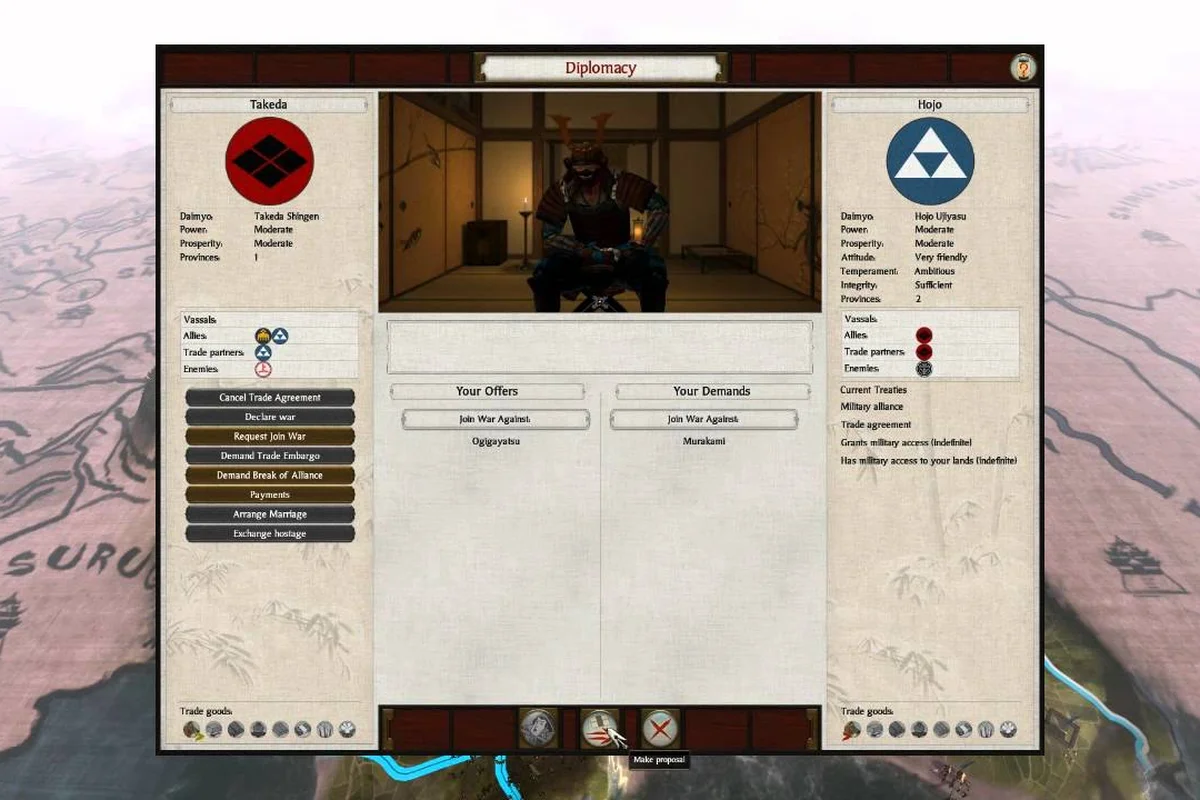
In co-op, allied human players cannot declare war on each other and gain a small trust bonus that improves trade income and joint recruitment. Head-to-head matches start as neutral, and the diplomacy screen is the only place to convert that into a non-aggression pact or a trade deal before realm divide turns the map red. Players who break a trade deal lose the trust bonus for several turns, and the AI remembers the betrayal when realm divide rolls around.
Late-Game Tech and Realm Divide Timing
Realm divide fires earlier for humans than for AI, so a co-op duo that has been winning should plan to be a turn or two ahead of the trigger curve. Late-game unit unlocks like Matchlock Samurai and heavy cavalry turn the tide on a single battlefield, so co-op players should pool research toward ranged infantry while the head-to-head player has to decide whether to invest in defense or rush Kyoto. The complete edition's Fall of the Samurai campaign, sold as a standalone expansion on Steam, adds modernized rifle units and railroads, but the Sengoku-era navy and realm divide rules stay the same for both products.
Frequently Asked Questions
How many players can join one Shogun 2 co-op campaign?
Two humans can co-op a single campaign, but the full lobby fills up to eight slots total when you add AI opponents or extra human players in head-to-head mode. The shared Sengoku map supports this cap consistently across the 2011 base game and the complete edition.
Can the same friend join both campaign and naval battle types?
Yes, a friend can play campaign with you on one session and then switch to naval custom battles on another, because the Steam friend list is shared but the lobby pools are separate. Many players keep one friend circle for the long Sengoku campaigns and another for the eight-player naval brawls.
What is the best way to handle a disconnect mid-campaign?
The host keeps playing, the save flushes at the end of the turn, and the dropped friend rejoins on the next campaign tick. The recovery is automatic as long as the host is the one who launched the match, because saves only write on the host's machine.
Does realm divide affect co-op differently than head-to-head?
Realm divide mechanics, as documented on the Total War wiki, fire for humans in both modes but AI allies stay loyal in co-op for several turns before defecting, while in head-to-head every clan turns hostile at once. Co-op duos therefore get a slightly longer window to prepare, but the late game is no less brutal for them.
Is the eight-player limit strict or can it be modded?
The eight-player cap is a hardcoded lobby limit, and most workshop mods leave it untouched, but a few community mods raise the slot count by editing the campaign script. Those mods usually break saves, so backing up the original campaign save is essential before installing a slot-expansion mod.
Shogun 2 Co-Op Etiquette, Community Picks, and a Clean Wrap
Sengoku lobbies are friendlier than most strategy game rooms because the player base skews older and turn-based pacing discourages rage quitting. Still, a few rules of etiquette keep the night on track: announce the campaign length before launching, agree on save-scumming policy for the host's client, and call out realm divide plans in the lobby chat. The best Shogun 2 competitive campaign guide for new players is to pick a faction that complements the co-op partner rather than a mirror, because pairings like Shimazu and Hattori cover each other's naval and ninja gaps without overlap.
Custom battle lobbies, on the other hand, are where the eight-player Sengoku brawls live, and the Steam Workshop catalogue of legacy mods, linked from the Steam Workshop hub, is the best place to find map packs and unit overhauls. The campaign launch settings carry over from the multiplayer menu in predictable ways, so once a co-op duo settles on a house rule set, replaying with a different faction set is a one-click affair. Naval multiplayer etiquette rewards players who cap points and stay alive rather than the one who chases a single kill across the map, and the long turns mean a polite lobby can get through two or three real-time battles in a single campaign year.
By the end of a successful session, a co-op duo will have weathered realm divide, survived at least one naval battle, and decided on a victory condition that suits both schedules. The 2011 base game's Steam store page still shows a strong review record, which is the best evidence that the underlying co-op design has aged well. The 2011 base game still holds up because the lobby flow rewards planning over reflexes, and the realm divide cliff keeps every shared campaign honest from the first turn to the last.